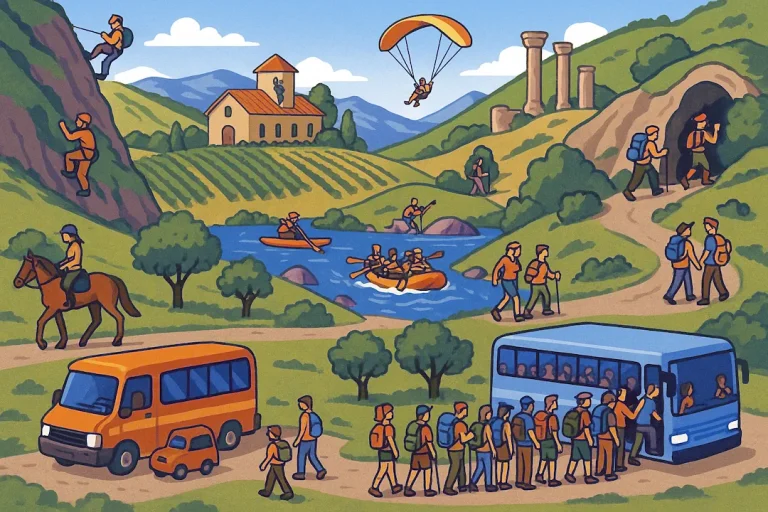
What happens when customers start taking part in the story instead of simply being its audience? An article on storytelling by Tor Kjølberg made me think about something that goes far beyond marketing: participation can create a sense of belonging, ownership and stories that no communications department could ever have written on its own.
My friend Tor Kjølberg recently wrote an article for Daily Scandinavian about how customers can become more actively involved as participants in a brand’s story.
Tor describes a progression in which a customer can move from being an observer to becoming engaged, then a contributor and co-creator, before perhaps eventually becoming someone who voluntarily shares the story with others. He calls the model the Customer Story Participation Ladder and describes the progression as: Observer, Engager, Contributor, Co-creator, Advocate and Ambassador.
The model can also be read as a description of how relationships between people and brands can develop through participation. In many ways, it is not that different from what happens when people do something together and build shared experiences and points of reference that bring them closer. That is part of the thinking behind team building: the activity itself is not necessarily the most important part, but rather what develops between people while they are taking part in it.
Storytelling is no longer just about telling a good story
Much of marketing and communication still relies on a fairly traditional model. A company has a message, a place has a story, or an organisation has something it wants to communicate, and the rest is about finding the right channels and making sure as many people as possible see it.
We measure reach, attention, clicks and response, constantly trying to become better at getting through to people. But reaching people is not necessarily the same as building a relationship. What if the most important question is not how well we tell our story, but how well we create something other people actually want to become part of?
When people participate, a relationship can emerge that is much harder to buy than attention, because they recognise their own contribution, their own experience or their own place within the larger whole. That does not necessarily turn them into loyal customers or enthusiastic ambassadors. But it can create a feeling that this matters to them, perhaps even a sense that “this is partly mine too.”

Customer participation can create stronger brands
What I find particularly interesting about Tor’s model is how an observer can gradually become a participant and eventually develop a sense of belonging. What makes an observer engage, and when does contributing turn into a feeling of ownership and connection?
There is probably no single answer, but certain mechanisms appear again and again. People are more likely to participate when something feels relevant to them, when the barrier to contributing is low, when their contribution is actually noticed, and when there is a genuine opportunity to influence the outcome. The feeling of learning something, mastering something or being part of a community can matter as well.
I have touched on something similar before in connection with user-driven innovation: when someone contributes an idea, it often makes sense for them to have an opportunity to help develop it further. Following an idea from suggestion to action can create a sense of ownership. Someone who sees that their contribution actually has consequences has moved from simply being heard to becoming part of the creation process.
The story may be what invites us in, but the experience of participating is what determines whether we want to stay.

From content strategy to participation strategy
Most organisations have by now developed some kind of approach to content strategy. They discuss which channels to use, what kind of content to produce, which audiences they want to reach and how often they should publish.
Far fewer ask equally systematic questions about how people can actually participate. What can customers contribute? What can they influence? How can they meet other people? How can their experiences and contributions become visible? What does it take for someone who follows an organisation from a distance to want to take that first small step inside?
And perhaps most importantly: what do people themselves get in return for participating?
While content strategy asks what we should tell people, participation strategy starts from the opposite direction: What should people be able to do together with us?
Travel and destination marketing show how the story can live on
The traditional model is for a destination to create compelling images, films and stories designed to persuade people to visit. But the visit itself can also become the beginning of a new story, rather than the end of the original campaign.
A guest who simply consumes an experience may return home with a pleasant memory. A guest who meets people, takes part in something, learns something, shares an experience or has an encounter that feels personal may return home with something much stronger: their own story about the place.
Perhaps destinations should not only ask which stories they want to tell about a place, but which stories they can make it possible for their guests to experience for themselves.
Customer loyalty is about more than purchases and reward points
A customer who buys a product has one kind of relationship with a company. A customer who shares experiences, helps other users, suggests improvements or participates in development has another.
This is also why customer loyalty cannot necessarily be reduced to repeat purchases, loyalty programmes and discounts. Someone can buy from the same company for years without feeling any particular connection to it. Another person may make far fewer purchases and yet feel a much stronger connection because the company represents an environment, an interest or a community they identify with.
One relationship is primarily economic. The other has also developed a social and personal dimension.

Co-creation only works when both sides gain something from it
Companies naturally appreciate customers who recommend them to others, create content, share experiences and speak positively about the brand. At its worst, “customer participation” can therefore become little more than a nicer way of describing free marketing. Genuine co-creation must create value in both directions.
People need to feel that they receive something meaningful in return, whether that is influence, knowledge, community, recognition, relationships or simply the feeling that they helped create something that matters. Otherwise, we risk extracting value from people and calling it engagement.
The same applies when brands collaborate with influencers: people are not merely distribution channels, and the best collaborations are built on trust, credibility and value for both sides. Read more in “How Influencers Create Trust, Engagement and Sales”.
The best brand stories cannot be controlled
We often talk about companies needing to own their own story, and naturally no one wants others to have complete control over how they are defined. At the same time, there is a limitation in the idea that a brand story can ever be fully owned and controlled.
The strongest stories often emerge precisely when some of that control is released.
A company can create the framework, open the door and invite people in. It can listen, facilitate and make participation possible. But what other people experience, and which stories they choose to share afterwards, can never be fully controlled.
Because the strongest story about a company, a destination or a place may not be the one written by its communications team. It may just as easily be the story that emerges within someone who initially came only to observe, but gradually discovered that they could participate and that their participation actually mattered.
When that person later tells the story to someone else, it is no longer only the company’s story. It has become partly theirs as well.
It is a little like a job interview: one thing is to tell people how capable you are yourself. It is quite another when someone with credibility and respect says it on your behalf. The same applies to brands. The stories other people choose to tell about you can carry far more weight than the stories you tell about yourself.
This article was inspired by Tor Kjølberg’s “Seven Strategies for Increasing Customer Participation in Brand Stories” on Daily Scandinavian, where he introduces the Customer Story Participation Ladder and explores how customers can move from observers to active participants and ambassadors for a brand.