
Many established theories have been challenged and developed further because someone questioned what others took for granted. Yet today, it can almost seem as though we have turned that around—as though you need a PhD to ask questions, rather than pursue one to investigate them. Why should a title determine whether we listen, when knowledge can also grow through experience, independent study and curiosity? Someone had to write the books in the first place.
Knowledge Came Before the Curriculum
Education is, among other things, a structured way of sharing knowledge. People before us explored the world, solved problems and shared what they discovered. Over time, experiences, methods and explanations were brought together and developed further. What was once an unanswered question could eventually become a chapter in a textbook.
But someone had to figure it out before others could read about it. They could learn from the people around them, build on previous experience and draw on knowledge from other fields. Even so, they had to contribute something that had not yet been described.
Before anyone could take an exam on that knowledge, someone had to develop it.
Wilhelm Wundt, one of the founders of experimental psychology, illustrates how a new field can emerge. He held a doctorate in medicine and drew on physiology and philosophy when he established his psychology laboratory in Leipzig in 1879. In other words, he used knowledge from existing disciplines to help develop a new one.
The point is not that the pioneers lacked prior knowledge, but that a field has to begin taking shape before anyone can hold a degree in it. Knowledge can develop before there is an established educational programme to certify it. And that possibility does not disappear once the textbooks have been written. There are still problems to solve, experiences to examine and connections we have yet to understand.
When Knowledge Becomes a Club
Education gives us access to knowledge, methods and perspectives that might otherwise take us a long time to discover. It has great value. The problem arises when we make one route to knowledge the only route we recognise.
Because what happens to those who learn in other ways? Those who read independently, build, repair, observe and try again? Those who spend years understanding a problem because they encounter it at work, or because their curiosity will not let it go?
That knowledge is not always captured in a diploma. It may reveal itself in solutions, sound judgement, precise questions and the ability to explain why something works. But we have to give people the opportunity to demonstrate it before we can assess it.
Think of an applicant who has spent years doing relevant work but lacks the degree listed in the job advertisement. If they are screened out before their experience is considered, have we really assessed their competence properly?
We say we want people who think in new ways. Then we also need to make room for people who have learned in ways different from our own.
Why Do You Need a PhD to Think Differently?
Of course, you do not. But there can be a difference between having an idea and getting someone to listen to it. An academic title can lend credibility before any arguments have been presented. Someone without that title may first have to explain why they are worth listening to.
Relevant expertise is a good reason to listen. But the absence of a particular degree should not, on its own, be enough to dismiss a question, an observation or a suggestion.
How can we discover what others have to contribute if we only listen to those who have followed a route we already recognise?
Sometimes it seems as though we have confused knowledge with approval. As though what matters most is that competence comes in the right packaging. But when someone can explain a problem, show how they have investigated it and provide evidence for a solution, that should count in our assessment.
Being heard is not the same as being right. Ideas must stand up to questions, criticism and testing. That requirement should apply to everyone, regardless of their title.
What Do You Know—and How Do You Use It?
You can have read extensively about psychology and still struggle to understand the person in front of you. You can have top grades in economics and still underestimate the importance of trust. Knowledge also needs to be applied, put into context and adapted to the situation.
Someone who works closely with a problem may notice details that others overlook. Someone who has studied the theories may see connections that are difficult to discover through experience alone. When these perspectives come together, we have more ways to understand what is actually happening.
Experience can be misinterpreted, and theory can be misapplied. That is why we need both a willingness to share what we know and a willingness to revise our understanding when we learn something new.
If we place too much emphasis on how someone has learned, we may overlook what they actually know. Along the way, we risk losing both talent and solutions.
When the Title Gets the Final Word
A title tells us something about a person’s background. It does not determine whether each argument holds up. Yet it can be tempting to let status do the judging for us. The question is whether we listen to the reasoning or let ourselves be persuaded by who is speaking.
Stanley Milgram’s obedience experiments in the 1960s examined another aspect of authority: the willingness to follow instructions to administer what participants believed were electric shocks to another person. The experiments concerned obedience, rather than directly examining how we assess the knowledge of someone with an academic title.
When considering an argument about a subject, we should ask: What is this based on? How has it been investigated? What might count against it? These questions help us move forward, whether the person speaking is a professor, a skilled tradesperson or someone who is self-taught.
Knowledge Is More Than a Piece of Paper
A diploma documents an education. It does not capture everything a person has learned throughout their life. Independent study, practical work, collaboration and personal investigations can also provide valuable insight.
That is why we should make more room for those who have taken alternative routes. Invite them into the conversation, ask them to show what they know, and examine their contributions with the same openness and care we give to anyone else’s.
Because that is what the question about the first book is really about: before knowledge could become part of a curriculum, someone had to develop it. And there is still more to discover.
Someone had to write the books in the first place. If we only listen to those who have studied what is already in them, we risk overlooking those who have something to contribute to the next one. Perhaps that is me—or you?
Read also: Why Does Everyone Have to Follow the Same Path to Get Ahead?
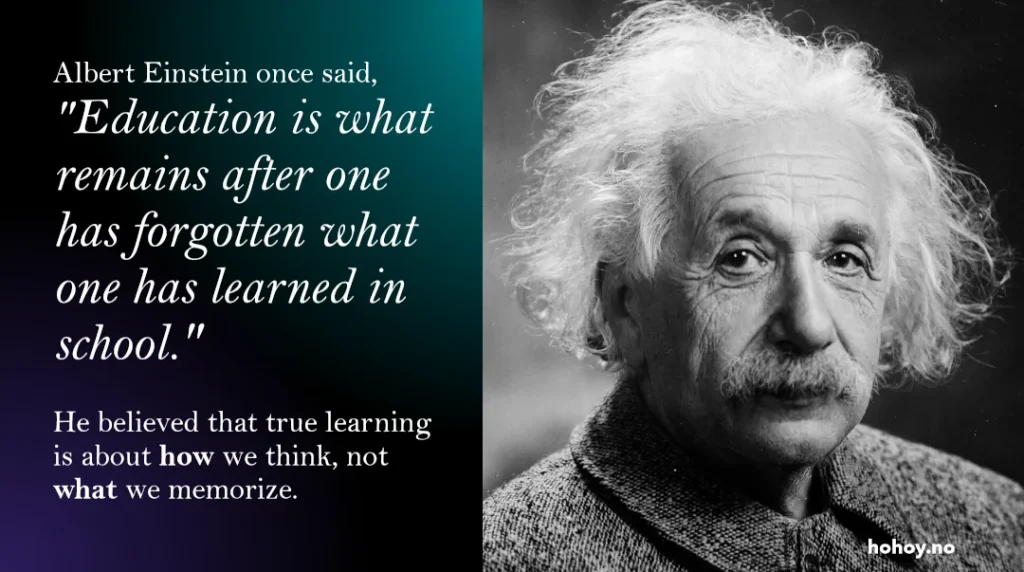
About the image: Einstein used a version of the statement about education, but attributed it to an unnamed person. Read about the quotation’s origins.


