If terms like SaaS, IaaS, PaaS, and all the other “aaS” terms feel overwhelming, you’re not alone. Over the years, I’ve gained first-hand experience with how these service models work. I’ve worked with SaaS solutions that make life easier for end users, and explored both IaaS and PaaS to build robust systems. I now think of them as tools in a toolbox, and in this article I’ll explain the differences between SaaS, IaaS, and PaaS in a way that (hopefully) makes them clear and useful to you.
From early video meetings to SaaS, IaaS, and PaaS
I remember working in the IT department at Tromsø University College. A technician and salesperson from one of our suppliers showed up at my office with a Codian MCU—a device that made it possible to bring several people together in the same video meeting. They wanted us to install it on our network for testing. At the time, Uninett had some of the best internet connections to Northern Norway, and the supplier’s aim was naturally to offer its services over our network to ensure the best possible quality. If you’d like to learn more about the evolution from older video conferencing equipment to today’s solutions, read about video conferencing codecs.
This was many years before “cloud services” became a mainstream term, and long before tools like Slack, Zoom, and Microsoft Office 365 became part of everyday life. What we now call Software as a Service (SaaS) was still largely unfamiliar. Salesforce may have been the only company at the time to establish a service that people could use directly in a web browser. I could never have imagined that a few years later I would lead the development of a global video conferencing service. The work on Easymeeting is featured in the Alibaba Cloud case study. I’ve also written more about the collaboration with ZTE and the development of Easymeeting.
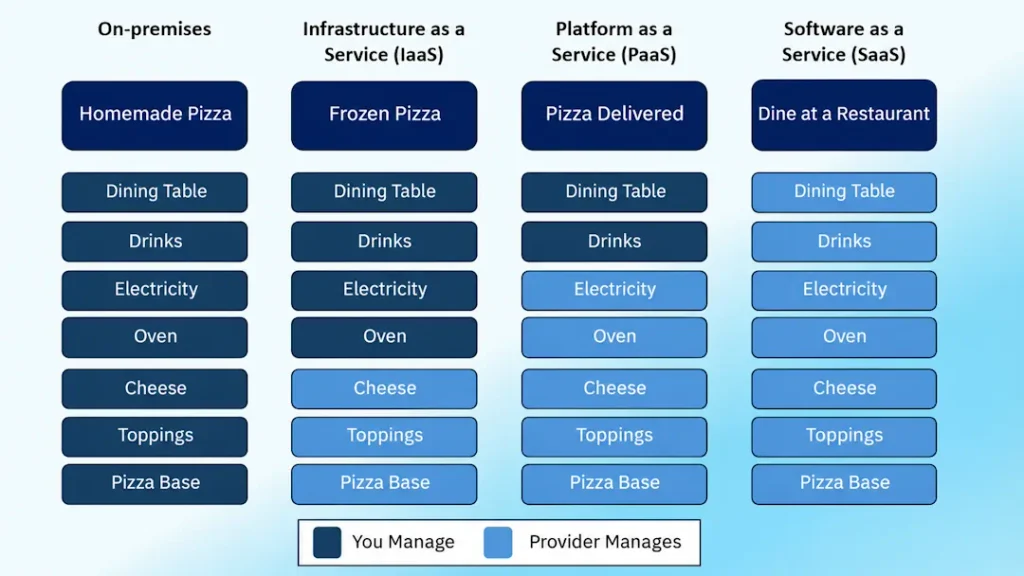
Below is an illustration of what the different digital service delivery models mean, using one of the best-known analogies in the industry: Pizza-as-a-Service.
Pizza as an analogy
Albert Barron popularized the pizza analogy in 2014. It compares service models to different ways of getting pizza. The key idea is who does the work—from sourcing the ingredients to making and serving the pizza.
- On-premises: You make the pizza from scratch at home. You take care of the ingredients, equipment, and preparation yourself.
- IaaS: You buy a pizza base and ingredients, then bake the pizza at home. Some of the work is done for you, but you’re still in charge of much of the process.
- PaaS: You order a ready-made pizza for delivery. You don’t have to manage the kitchen or do the baking, but you still choose what you want and make sure the order is right.
- SaaS: You eat at a restaurant. The provider takes care of most of the preparation and serving, while you use what’s on offer.
The analogy is useful for understanding how responsibilities are divided, but it isn’t perfect. For example, developers still need to build and maintain the application on a PaaS platform. And even with SaaS, customers are often responsible for things like users, content, and settings.
What do the terms mean in practice?
- On-premises:
The software runs on equipment the organization owns or operates, such as servers in its own offices or in a data center. The organization has a high degree of control, but must also take care of hardware, updates, operations, and security.
On-premises is not a cloud service model, but it’s a useful point of comparison: the organization manages most things itself.
- IaaS (Infrastructure as a Service):
With IaaS, you rent basic IT resources such as servers, storage, and networking from a provider. You don’t have to buy or maintain the physical hardware, but you’re usually responsible for the operating system and the software you run on it.
Providers offering IaaS include AWS, Microsoft Azure, and Google Cloud. What you need to manage depends on the specific service.
- PaaS (Platform as a Service):
PaaS gives developers a platform for building and running applications. The provider manages more of the infrastructure and operating environment, so developers can spend more time on the application itself.
Examples include Heroku, Google App Engine, and Azure App Service. You’re still responsible for the application and the content you put into it, but you avoid much of the work involved in managing servers and the platform.
- SaaS (Software as a Service):
With SaaS, you use a finished software product that the provider operates and makes available over the internet. You typically sign in through a browser or app, while the provider manages the underlying infrastructure and maintains the software.
Google Workspace, Salesforce, and Dropbox are examples. Customers often still need to manage users, access, data, and settings.
In short
As you move from on-premises to IaaS and PaaS, and then to SaaS, the provider generally takes care of more of the technical operations. In return, you often have less control over the underlying layers. The details vary from service to service, but this is a useful rule of thumb.
Pizza gives us a simple way to picture it: you can do almost everything yourself, get help with some of the steps, or order a finished product. The right model depends on how much control and responsibility you want—and on what you need to build or use. To learn more about the practical side of cloud services, read about the flexibility and scalability of cloud services.