
A competitor can help create the customers you will later compete for. When few people know about a destination, it may be too early to fight for market share. First, more people need to understand why the place is worth the trip. When businesses help make it known and appealing, they can all compete in a larger market. This combination of cooperation and competition is called coopetition.
From Cooperation to Competition
When I told a friend that I was helping a Swiss couple with photos and information so they could organize paragliding trips to Drama, the response came quickly:
“Why do you do that and don’t take it yourself?”
A little later came: “I hope you get a cut or something.”
That is an understandable reaction if you see business as a series of individual transactions: one business wins the customer, and another loses them. But in emerging markets, especially in tourism and destination development, that is not always how it works.
A classic mistake in destination development is to assess each offering on its own. A place can have good flying conditions, beautiful scenery, great food, welcoming accommodation, and lovely hiking trails, without any one of these being enough on its own to persuade people to travel there. When the offerings work together, the overall experience can make the trip worthwhile.
It is a bit like soup: onion, carrot, potato, celery, stock, and seasoning each have their own role. A soup made with just one ingredient quickly becomes boring; the flavor gains depth when several ingredients come together. A destination works the same way. One business can offer a great experience, but it rarely has the ability to make a place well known and appealing enough to grow the market on its own. That happens when several businesses each contribute something and give people more reasons to visit.
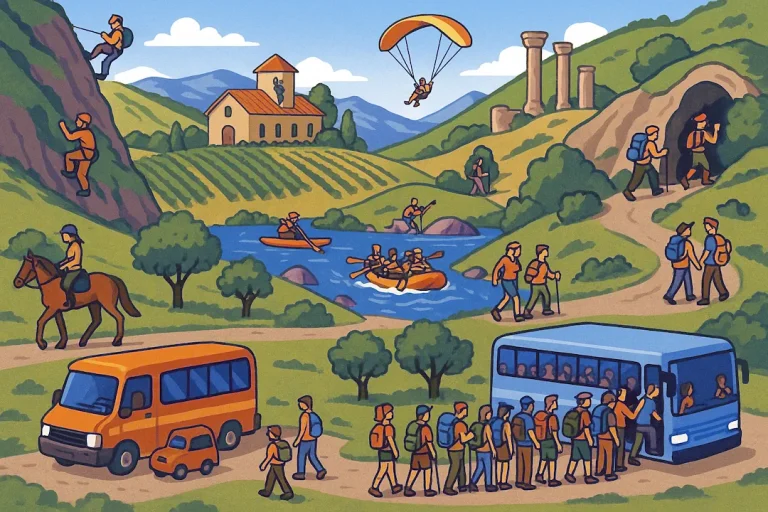
What Does Coopetition Mean?
Coopetition combines the English words cooperation and competition. The term describes situations where businesses compete in some areas while cooperating where they share common interests. A research review of coopetition describes how businesses can cooperate and compete at the same time.
Not every business around a destination competes directly with the others. But coopetition happens when businesses that also compete cooperate to develop something they can all benefit from.
Restaurants in the same area may compete for diners, but they also benefit when the area earns a good reputation. Hotels compete for bookings, but they also want better transport links and more visitors. Tour operators compete for customers, but they can cooperate to raise awareness of the destination.
The same applies to paragliding in Drama. We can compete over who sells the trips while sharing an interest in getting more pilots to consider Drama as a destination. I have written more about everything Drama has to offer in a separate article.
First, People Have to Choose the Destination
If Drama were already an established paragliding destination with many international visitors, the main question might be which operator offers the best price, service, or trip package.
But before a paraglider pilot can choose between operator A and operator B, they first have to choose Drama. To do that, they need to:
- know that Drama is a place to go flying
- understand what the area has to offer
- find reliable, useful information
- see photos, videos, and accounts from other pilots
- feel confident enough to book the trip
The Swiss pilots may already know the operators. They may prefer to book through someone in their own country, communicate in their own language, or travel with a group they already trust. Perhaps they would never have heard of Drama if the couple had not introduced them to the place.
In that case, I have not necessarily lost a customer. Those pilots might never have come to Drama without the operators. Instead, the destination has gained new visitors who can share photos, videos, and flight logs, recommend the area to others, or return later. In this way, many small contributions gradually build awareness and trust in a destination.
Having several operators does not mean they all need to sell the same trip to the same customers. A Swiss operator can reach Swiss pilots, while I can focus on Norwegian or Nordic pilots. Some groups want dedicated paragliding trips; others want to combine flying with food, wine, hiking, or other local experiences. Some travel in spring, others in autumn.
More providers therefore do not automatically mean that everyone is splitting the same pool of customers. In an early stage, they can expand the market and make the destination relevant to more people.
Cooperating Without Sharing Everything
Cooperation between competitors does not mean everyone has to share business secrets. They can work together on things that make the destination better while each business stays in control of what sets its own offering apart.
For a paragliding destination, it can make sense to cooperate on:
- general information about the area and flying sites
- safety and local conditions
- transport, accommodation, and practical information
- photos and marketing for the destination
- initiatives that make it easier for new pilots to get there
Each business can keep its customer lists, prices, supplier agreements, unique concepts, and strategic plans to itself. The idea is to cooperate where it creates more value for everyone, and compete on what makes each offering different.

Competition Comes as the Market Grows
There is little value in controlling half of a market that barely exists. If several reputable operators bring groups to Drama, that can raise its profile in more countries and languages, generate more reviews and recommendations, and build credibility for the area as a paragliding destination.
If Drama eventually becomes an established destination, competition will naturally focus more on price, quality, service, concepts, availability, and customer experience. That is not necessarily a problem. It may be a sign that the market has developed.
Coopetition is relevant well beyond paragliding. It can play a role in other areas of tourism, as well as in technology, retail, events, food production, and startup communities—especially where several businesses depend on a market or ecosystem growing.
That is why I am happy to help my Swiss friends with photos and information. I do not necessarily need a percentage of their trips for it to be worthwhile for me. If they bring more pilots to Drama, and those pilots have a good experience and tell others about the area, they help make the destination stronger. That can also make it easier for me to develop my own offerings later.
We can compete for customers once they arrive. First, we need to cooperate to give them a reason to come here.


